Durood e Kashaf: Its Meaning, Spiritual Reflection and Words About Relief
Durood e Kashaf: Its Meaning, Spiritual Reflection and Words About Relief
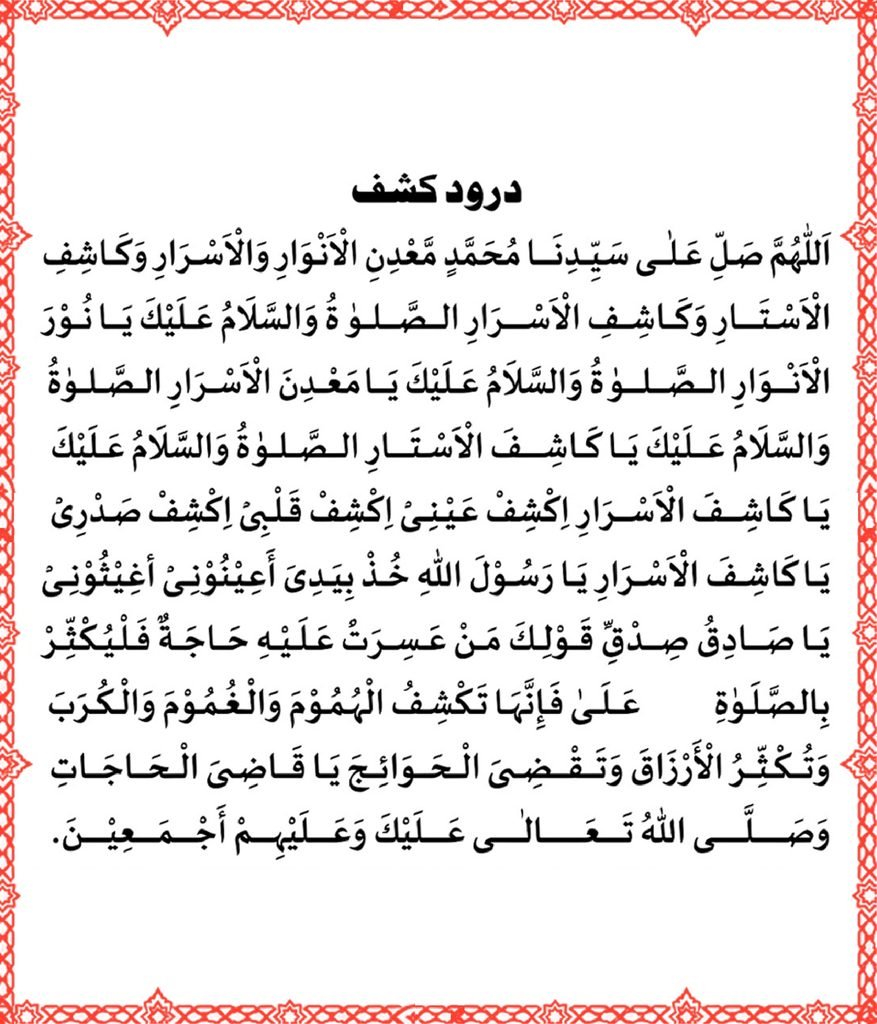
Durood e Kashaf is a devotional salutation that centres on sending blessings and peace upon Prophet Muhammad ﷺ. The version shown in your image uses expressions such as Madin al-Anwar (the source of lights), Kashif al-Asrar (the one associated in the text with unveiling secrets), and Kashif al-Astar (the one associated with unveiling veils).
What makes this version distinctive is that it moves from praise and Salawat to words asking for help, the unveiling of difficulties, and relief from worries. Understanding these expressions helps readers approach the Durood with greater care instead of treating it as just another text to repeat.
Durood e Kashaf in Arabic
The following transcription is based on the image you supplied. Please retain your original image as the reference when publishing, particularly for checking the diacritical marks.
بِسْمِ اللَّهِ الرَّحْمَٰنِ الرَّحِيمِ
اللَّهُمَّ صَلِّ عَلَى سَيِّدِنَا مُحَمَّدٍ مَعْدِنِ الْأَنْوَارِ وَالْأَسْرَارِ وَكَاشِفِ الْأَسْتَارِ وَكَاشِفِ الْأَسْرَارِ
الصَّلَاةُ وَالسَّلَامُ عَلَيْكَ يَا نُورَ الْأَنْوَارِ
الصَّلَاةُ وَالسَّلَامُ عَلَيْكَ يَا مَعْدِنَ الْأَسْرَارِ
الصَّلَاةُ وَالسَّلَامُ عَلَيْكَ يَا كَاشِفَ الْأَسْتَارِ
الصَّلَاةُ وَالسَّلَامُ عَلَيْكَ يَا كَاشِفَ الْأَسْرَارِ
اِكْشِفْ عَيْنِي اِكْشِفْ قَلْبِي اِكْشِفْ صَدْرِي
يَا كَاشِفَ الْأَسْرَارِ يَا رَسُولَ اللَّهِ خُذْ بِيَدِي أَعِينُونِي أَعِينُونِي
يَا صَادِقَ صَدَقَ قَوْلُكَ مَنْ عَسُرَتْ عَلَيْهِ حَاجَةٌ فَلْيُكْثِرْ بِالصَّلَاةِ عَلَيْكَ فَإِنَّهَا تَكْشِفُ الْهُمُومَ وَالْغُمُومَ وَالْكُرَبَ وَتُكَثِّرُ الْأَرْزَاقَ وَتَقْضِي الْحَوَائِجَ
يَا قَاضِيَ الْحَاجَاتِ
وَصَلَّى اللَّهُ تَعَالَى عَلَيْكَ وَعَلَيْهِمْ أَجْمَعِينَ
Note: The image contains devotional wording whose exact punctuation and some grammatical details may vary between copies. Compare this transcription against the image before publishing the Arabic as a definitive version.
Durood e Kashaf Transliteration
Bismillahir-Rahmanir-Raheem.
Allahumma salli ‘ala sayyidina Muhammadin ma‘dinil-anwari wal-asrari wa kashifil-astari wa kashifil-asrar.
As-salatu was-salamu ‘alayka ya nur al-anwar.
As-salatu was-salamu ‘alayka ya ma‘dinal-asrar.
As-salatu was-salamu ‘alayka ya kashifal-astar.
As-salatu was-salamu ‘alayka ya kashifal-asrar.
Ikshif ‘ayni, ikshif qalbi, ikshif sadri.
Ya kashifal-asrar, ya Rasul Allah, khudh biyadi, a‘inuni, a‘inuni.
Ya sadiqa sadaqa qawluka, man ‘asurat ‘alayhi hajah fal-yukthir bis-salati ‘alayka, fa-innaha takshiful-humuma wal-ghumuma wal-kurab, wa tukaththirul-arzaqa wa taqdi al-hawa’ij.
Ya qadiyal-hajat.
Wa sallallahu ta‘ala ‘alayka wa ‘alayhim ajma‘in.
This transliteration is an approximate pronunciation guide. For accurate recitation, use the Arabic text and seek help from someone familiar with Arabic pronunciation.
Durood e Kashaf Meaning in English
The wording of Durood e Kashaf can be explained in several parts.
The opening asks Allah to send blessings upon Prophet Muhammad ﷺ, describing him with expressions related to lights, secrets, and the unveiling of veils. The following lines repeat greetings of peace and blessings, addressing him with these devotional descriptions.
The text then contains phrases asking for unveiling or opening: “unveil my eye, unveil my heart, unveil my chest.” These expressions may be understood as requests for clarity, inner understanding, and the easing of what weighs upon a person.
The later passage refers to worries, grief, hardships, provision, and needs. In broad terms, it encourages the reader to turn towards Salawat during difficulty.
This is an explanatory rendering of the text, not a formal scholarly translation. Some of its expressions have devotional and theological nuances that may need further explanation from a knowledgeable scholar.
What Makes Durood e Kashaf Different?
Durood e Kashaf stands out because its wording repeatedly uses the language of unveiling. Rather than focusing only on praise, it also speaks about what is hidden, what is difficult to understand, and what a person hopes will become clear.
1. The Language of Light and Hidden Things
The phrases Nur al-Anwar and Ma‘din al-Asrar refer to light and secrets. They give the Durood its distinctive devotional style. Readers should understand these expressions within the tradition in which the text is used rather than assume that a brief English translation explains every theological implication.
2. The Request to Unveil the Heart and Chest
The lines Ikshif qalbi and Ikshif sadri can be translated approximately as “unveil my heart” and “unveil my chest.” These words invite reflection on inner clarity, understanding, and the desire to move beyond confusion or distress.
A reader may use this part of the text as a reminder to seek guidance, reflect honestly, and ask Allah for what is good.
3. Words About Worries and Hardship
The closing passage refers to humum, ghumum, and kurab—terms associated with worries, grief, and distress. This helps explain why the text may be meaningful to someone going through a difficult period.
However, the wording should not be presented as proof that reciting a particular formula guarantees that every hardship will disappear. Muslims place their trust in Allah while continuing to take sensible steps to address their circumstances.
Why Do People Turn to Salawat During Difficult Times?
When life becomes uncertain, people often seek ways to reconnect with their faith. Sending blessings upon the Prophet ﷺ is one form of Islamic remembrance that can be included in a devotional routine.
Durood e Kashaf has particular language about worries and the unveiling of difficulties. Readers may find it helpful to pause over those words and reflect on what they are asking for.
- For reflection: Consider what the words about the heart and chest mean to you.
- For remembrance: Recite with attention rather than rushing through the lines.
- For dua: Ask Allah directly for guidance, ease, and what is best.
- For practical support: Seek appropriate advice and take reasonable action when facing a real-life problem.
The purpose of Salawat is not to replace other religious duties or practical effort. It is part of a person’s relationship with faith and worship.
Is There a Fixed Recitation Count for Durood e Kashaf?
The image you supplied does not specify a number of repetitions. Therefore, it would be misleading to claim that this version must be recited a certain number of times.
If a particular teacher or devotional tradition recommends a count, ask about the source of that recommendation and whether it is a personal practice, a traditional recommendation, or a religious requirement. Avoid promising that a particular number will certainly bring wealth, remove every difficulty, or fulfil a specific wish.
You can include Salawat in your daily remembrance without assuming that one specific count is compulsory.
How to Read Durood e Kashaf With Understanding
Begin by learning the Arabic wording and checking the pronunciation. The transliteration can help, but it cannot fully represent every Arabic sound.
Next, focus on the phrases that give this Durood its character: the references to light and secrets, the request to unveil the heart, and the closing words about worries and needs.
Finally, approach the text with sincerity and sound religious guidance. If a phrase raises a theological question, it is better to ask a qualified scholar than rely on a literal translation alone.
Frequently Asked Questions About Durood e Kashaf
What is Durood e Kashaf?
Durood e Kashaf is a devotional text that sends blessings and peace upon Prophet Muhammad ﷺ. The version in your image contains distinctive expressions about light, secrets, unveiling, and relief from difficulties.
What does “Kashaf” mean?
The word is associated with uncovering, unveiling, or making something clear. In the context of this Durood, the language of unveiling appears in several phrases, including the requests concerning the eye, heart, and chest.
Can I recite Durood e Kashaf during difficult times?
You may include Salawat in your devotional practice and make dua to Allah for guidance and relief. The text’s wording refers to hardship, but it should not be treated as a guarantee of a particular outcome.
Does Durood e Kashaf have a special recitation count?
No count is shown in your supplied image. If you follow a specific practice, seek reliable guidance about its source rather than assuming a number is compulsory.
What is the difference between Durood e Kashaf and Durood e Ibrahimi?
They have different wording and structure. Durood e Ibrahimi is a well-known form of Salawat recited in salah, while the version of Durood e Kashaf shown here has distinctive language about unveiling and the easing of worries.
You can also read our article on Durood e Ibrahimi to explore another form of Salawat.
Conclusion
Durood e Kashaf has a distinctive focus on light, unveiling, and the difficulties that weigh upon a person. Its wording moves from sending blessings and peace upon Prophet Muhammad ﷺ to expressions about seeking clarity and relief.
Understanding these themes makes it easier to approach the text thoughtfully. Read the Arabic carefully, consider the meaning, and ask knowledgeable people when you need help interpreting devotional expressions. Above all, avoid unsupported promises about fixed counts or guaranteed results, and keep your worship grounded in sincerity and trust in Allah.