Durood e Akbar: Arabic Text, English Translation and Transliteration
Durood e Akbar: Arabic Text, English Translation and Transliteration
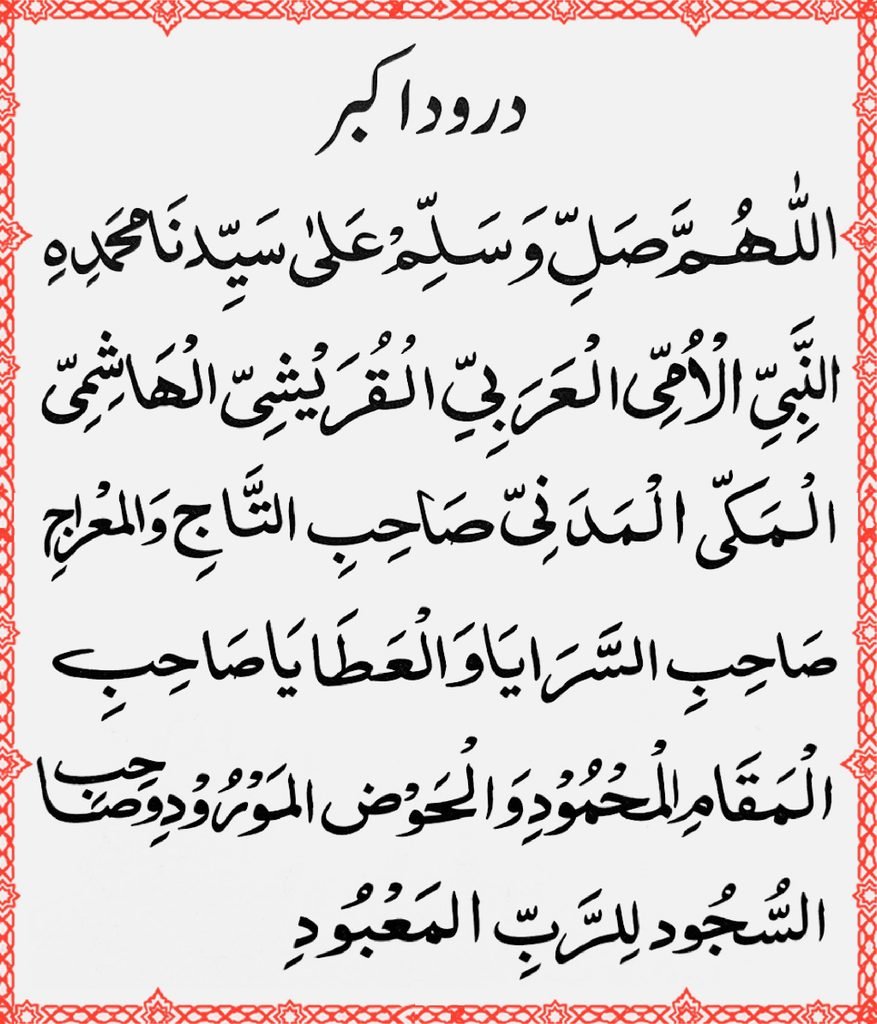
Durood e Akbar, also spelled Darood-e-Akbar, is a devotional prayer asking Allah to send blessings and peace upon Prophet Muhammad ﷺ. The wording includes several descriptions associated with the Prophet’s identity, honour, and devotion to Allah.
Many readers search for Durood e Akbar Arabic text, its English translation, and its transliteration to understand the prayer and learn how to read it. This guide presents the version shown in the supplied PDF, along with its meaning and pronunciation guide.
Durood e Akbar Arabic Text
اللَّهُمَّ صَلِّ وَسَلِّمْ عَلَى سَيِّدِنَا مُحَمَّدٍ النَّبِيِّ الْأُمِّيِّ الْعَرَبِيِّ الْقُرَشِيِّ الْهَاشِمِيِّ الْمَكِّيِّ الْمَدَنِيِّ صَاحِبِ التَّاجِ وَالْمِعْرَاجِ صَاحِبِ السَّرَايَا وَالْعَطَايَا صَاحِبِ الْمَقَامِ الْمَحْمُودِ وَالْحَوْضِ الْمَوْرُودِ صَاحِبِ السُّجُودِ لِلرَّبِّ الْمَعْبُودِ
Durood e Akbar Transliteration in English
Allahumma salli wa sallim ‘ala Sayyidina Muhammadin, an-nabiyyil-ummiyyil-‘arabiyyil-qurashiyyil-hashimiyyil-makkiyyil-madaniyy, sahib-it-taji wal-mi’raji, sahib-is-saraya wal-‘ataya, sahib-il-maqam-il-mahmudi wal-hawd-il-mawrudi, sahib-is-sujudi lir-rabb-il-ma’bud.
Simple Pronunciation Guide
Read the prayer slowly and divide it into shorter phrases. Pay attention to the longer words, such as al-maqam al-mahmud and al-hawd al-mawrud.
English transliteration is a pronunciation aid, not an exact representation of every Arabic sound. Reading the transliteration alongside the Arabic text can help you become more familiar with the wording.
Durood e Akbar English Translation
The following is an approximate English translation of the wording shown in the supplied PDF.
“O Allah, send blessings and peace upon our master Muhammad, the unlettered Prophet, the Arab, the Qurayshi, the Hashimi, the Makkan, and the Madinan; the possessor of the crown and the Ascension; the one associated with expeditions and gifts; the possessor of the Praiseworthy Station and the frequented pool; the one who prostrates to the Lord who alone is worshipped.”
Some expressions in this prayer are devotional titles, so their English wording may vary between translations. This rendering aims to communicate the general meaning of the Arabic text.
Understanding the Meaning of Durood e Akbar
Understanding the phrases in Durood e Akbar can help readers appreciate the wording and its devotional message.
Allahumma salli wa sallim: This means “O Allah, send blessings and peace.” It is a supplication asking Allah to bestow blessings and peace upon Prophet Muhammad ﷺ.
An-Nabiyyil-Ummiyy: This phrase means “the unlettered Prophet.” It is one of the descriptions used in the prayer.
Al-Arabiyy, Al-Qurashiyy and Al-Hashimiyy: These expressions refer to the Prophet’s Arab identity and his Qurayshi and Hashimi lineage.
Al-Makkiyy and Al-Madaniyy: These descriptions associate the Prophet ﷺ with Makkah and Madinah, two important cities in Islamic history.
Sahib-it-Taj wal-Mi’raj: This can be translated as “the possessor of the crown and the Ascension.” It is devotional wording expressing honour and referring to the Mi’raj.
Sahib-il-Maqam-il-Mahmud: This means “the possessor of the Praiseworthy Station.” The phrase refers to an honoured station mentioned in Islamic devotional language.
Sahib-is-Sujudi lir-Rabb-il-Ma’bud: This means “the one who prostrates to the worshipped Lord.” It highlights devotion and submission to Allah.
Together, these descriptions form a prayer asking Allah to send blessings and peace upon the Prophet ﷺ while expressing reverence for him.
Reciting Durood e Akbar
If you are learning Durood e Akbar, take time to understand both its wording and its meaning. Breaking the text into smaller phrases may make it easier to read and remember.
Follow these simple suggestions:
- Begin by reading the Arabic text carefully.
- Use the English transliteration as a guide.
- Read the translation to understand the phrases.
- Practise unfamiliar words separately.
- Ask a knowledgeable Arabic reader for help with pronunciation when needed.
Focus on correct pronunciation and understanding instead of rushing through the prayer. This article does not prescribe a particular recitation time or number of repetitions.
Benefits and Source Notes
Sending blessings upon Prophet Muhammad ﷺ is an important devotional practice in Islam. Muslims recite Durood Sharif to express love and respect for the Prophet ﷺ and to ask Allah to bestow blessings upon him.
Reading Durood e Akbar with an English translation can help readers understand its descriptive phrases and devotional language.
However, specific claims about guaranteed outcomes, special rewards, or prescribed recitation counts require reliable religious evidence. The popularity of a prayer does not, by itself, establish that its exact wording is an authenticated Hadith.
Different wordings are published under the name Durood e Akbar. This article follows the version supplied in the PDF rather than combining it with other versions. Readers who want to establish the historical source of this wording or verify claims about its particular merits should consult reliable Islamic scholarship.
Frequently Asked Questions
What is Durood e Akbar?
Durood e Akbar is a devotional prayer that asks Allah to send blessings and peace upon Prophet Muhammad ﷺ. The version in this article includes descriptions related to his lineage, the Ascension, and the Praiseworthy Station.
What does Durood e Akbar mean in English?
Its general meaning is a request for Allah to send blessings and peace upon the Prophet ﷺ, followed by titles that express reverence and describe his honoured status.
What does “Al-Maqam Al-Mahmud” mean?
Al-Maqam Al-Mahmud means “the Praiseworthy Station.” It is an expression referring to an honoured station in Islamic devotional language.
Are all versions of Durood e Akbar the same?
No. Different wording may appear under the same name in online collections and printed materials. The Arabic text in this article follows the supplied PDF.
Can I learn Durood e Akbar through English transliteration?
Yes. Transliteration can help you become familiar with the wording, but it does not represent every Arabic sound exactly. For accurate pronunciation, use the Arabic text and seek guidance from a knowledgeable reader.
Is this wording an authenticated Hadith?
The supplied PDF identifies the prayer as Durood e Akbar but does not establish its chain of transmission or authenticity as a Hadith. Do not attribute the exact wording to the Prophet ﷺ as a Hadith without reliable evidence.
Is a particular recitation count prescribed for Durood e Akbar?
This article does not establish a prescribed count. Any recommendation involving a particular number and a specific religious reward should be verified through reliable Islamic sources.