Durood e Mehmood: The Meaning of Its Praise, Spiritual Descriptions and Salawat
Download Durood e Mehmood .pdf
Durood e Mehmood is a form of Salawat whose wording contains several expressive descriptions of Prophet Muhammad ﷺ. It refers to him through phrases associated with light, divine mercy, spiritual knowledge, and an honoured rank. Rather than being a short, simple salutation, this Durood uses a series of titles and descriptions before asking Allah to send blessings and peace upon the Prophet ﷺ and his family.
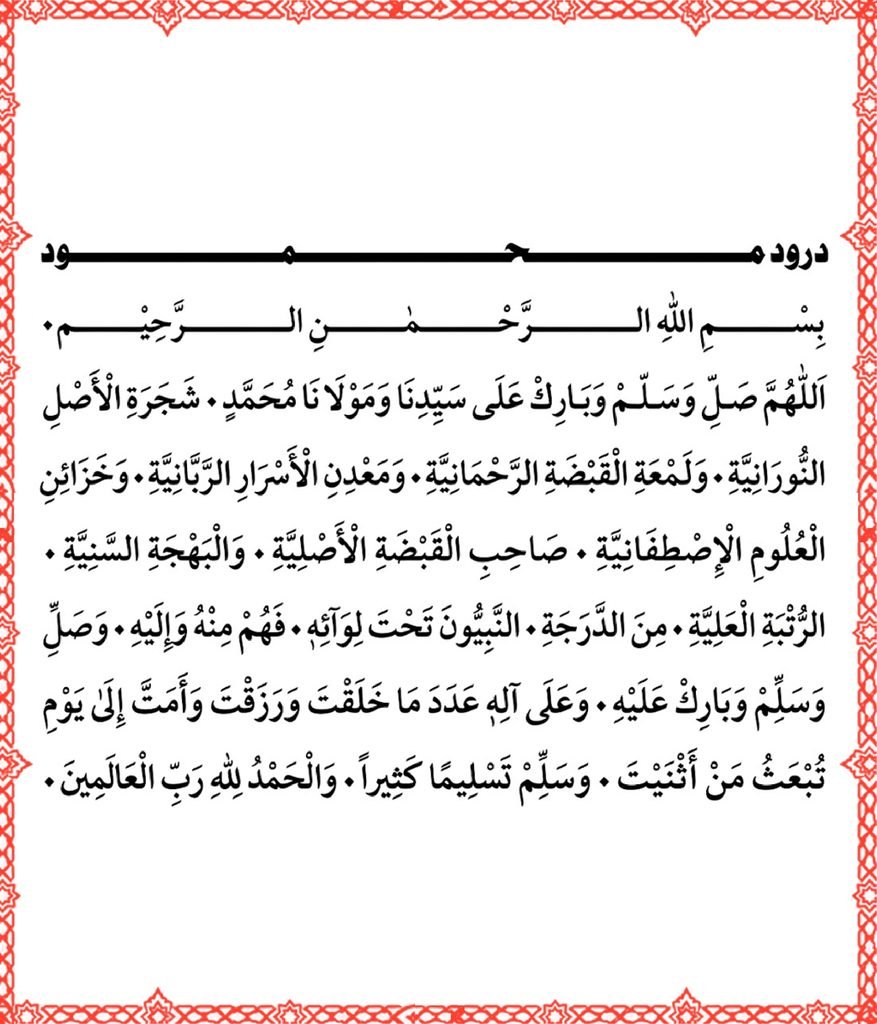
The text provided in your image has a distinctive structure. It begins with the remembrance of Allah, continues with praise of the Prophet ﷺ, and ends with a request for blessings in great abundance. In this article, we will look at the Arabic wording, transliteration, approximate meaning, and the main themes found in Durood e Mehmood.
Durood e Mehmood in Arabic
The following text is transcribed from your supplied image:
بِسْمِ اللَّهِ الرَّحْمَٰنِ الرَّحِيمِ
اللَّهُمَّ صَلِّ وَسَلِّمْ وَبَارِكْ عَلَى سَيِّدِنَا وَمَوْلَانَا مُحَمَّدٍ. شَجَرَةِ الْأَصْلِ النُّورَانِيَّةِ. وَلَمْعَةِ الْقَبْضَةِ الرَّحْمَانِيَّةِ. وَمَعْدِنِ الْأَسْرَارِ الرَّبَّانِيَّةِ. وَخَزَائِنِ الْعُلُومِ الْإِصْطِفَائِيَّةِ. صَاحِبِ الْقَبْضَةِ الْأَصْلِيَّةِ. وَالْبَهْجَةِ السَّنِيَّةِ. وَالرُّتْبَةِ الْعَلِيَّةِ. مِنَ الدَّرَجَةِ. النَّبِيُّونَ تَحْتَ لِوَائِهِ. فَهُمْ مِنْهُ وَإِلَيْهِ. وَصَلِّ وَسَلِّمْ وَبَارِكْ عَلَيْهِ. وَعَلَى آلِهِ عَدَدَ مَا خَلَقْتَ وَرَزَقْتَ وَأَمَتَّ إِلَى يَوْمِ تُبْعَثُ مَنْ أَنْبَتَ. وَسَلِّمْ تَسْلِيمًا كَثِيرًا. وَالْحَمْدُ لِلَّهِ رَبِّ الْعَالَمِينَ.
Note: The Arabic above follows the supplied image. A few expressions in the source have unusual or difficult wording and should be checked against a clear original copy or a qualified Arabic reader before publication as a definitive transcription.
Durood e Mehmood Transliteration
Bismillahir-Rahmanir-Raheem.
Allahumma salli wa sallim wa barik ‘ala Sayyidina wa Mawlana Muhammadin. Shajaratil-aslin-nuraniyyah. Wa lam‘atil-qabdhatir-rahmaniyyah. Wa ma‘dinal-asrarir-rabbaniyyah. Wa khaza’inil-‘ulumil-istifa’iyyah. Sahibil-qabdhatil-asliyyah. Wal-bahjatil-saniyyah. War-rutbatil-‘aliyyah. Minad-darajah. An-nabiyyuna tahta liwa’ihi. Fahum minhu wa ilayhi. Wa salli wa sallim wa barik ‘alayhi. Wa ‘ala aalihi ‘adada ma khalaqta wa razaqta wa amatta ila yawmi tub‘athu man anbat. Wa sallim tasliman kathira. Wal-hamdu lillahi Rabbil-‘alamin.
This transliteration is an approximate reading aid. For accurate pronunciation, use the Arabic text and ask a knowledgeable reader to check any unfamiliar expressions.
Durood e Mehmood Meaning in English
The wording can be understood broadly as follows:
“In the name of Allah, the Most Compassionate, the Most Merciful.
O Allah, send blessings, peace, and abundance upon our master and guide Muhammad ﷺ. He is described through expressions of the luminous origin, a manifestation of divine mercy, a source of divine mysteries, and a treasure of chosen knowledge. He is described as the possessor of an original spiritual rank, noble splendour, and an elevated station. The text also refers to the prophets being beneath his banner and connected with him.
O Allah, send blessings, peace, and abundance upon him and his family in a number beyond what You have created, provided for, and brought to an end, until the Day of Resurrection. Send abundant peace, and all praise belongs to Allah, Lord of all worlds.”
This is an explanatory rendering, not a word-for-word scholarly translation. Some phrases in the supplied text are difficult to interpret literally, so their precise meaning should be confirmed by a qualified Arabic scholar.
The Main Themes Found in Durood e Mehmood
The wording of this Durood is notable for its descriptive style. Several phrases stand out and help explain its overall devotional character.
1. Praise Through Expressions of Light
The phrase Shajaratil-aslin-nuraniyyah uses the imagery of a luminous tree or origin. This is poetic language found in the supplied text. It gives the opening description a sense of light and honour.
When reading this expression, it is useful to recognise it as devotional wording rather than treat every metaphor as a literal statement.
2. References to Divine Mercy
The expression al-qabdhatir-rahmaniyyah includes a reference to mercy. The Durood therefore connects its praise with the idea of divine compassion.
For readers, this can be a reminder to reflect on mercy and kindness in their own conduct, alongside sending blessings upon the Prophet ﷺ.
3. Knowledge and Spiritual Mysteries
The phrases ma‘dinal-asrarir-rabbaniyyah and khaza’inil-‘ulumil-istifa’iyyah refer to divine mysteries and chosen knowledge. They form part of the elevated language used throughout the Durood.
These expressions are best approached with care. Their detailed theological interpretation should be taken from reliable scholarship rather than assumed from a simple translation.
4. An Honoured and Elevated Rank
The text also uses expressions such as al-bahjatil-saniyyah and ar-rutbatil-‘aliyyah, which convey ideas of noble splendour and an elevated rank.
Together, these descriptions give Durood e Mehmood its particular style: an extended expression of reverence followed by a prayer for blessings and peace.
Why Does Durood e Mehmood Use So Many Descriptive Phrases?
Some forms of Salawat are brief and direct. Others contain longer descriptions and poetic expressions. Durood e Mehmood belongs to the latter style.
Its wording builds a sequence of descriptions before returning to the central request: that Allah send blessings, peace, and abundance upon Prophet Muhammad ﷺ and his family.
This structure makes the Durood different from shorter forms such as Durood e Ibrahimi. If you are exploring different forms of Salawat, comparing their wording can help you appreciate the variety of devotional expression.
Is There a Fixed Recitation Count for Durood e Mehmood?
The supplied image does not mention a specific number of repetitions. For that reason, it would not be appropriate to state that this Durood must be recited a certain number of times.
If you have received a particular count from a teacher or devotional tradition, ask for its source and whether it is a personal recommendation or an established religious instruction.
You can include Salawat in your daily remembrance without assuming that a particular number is compulsory or guarantees a specific result.
How to Read Durood e Mehmood With Understanding
Because this Durood contains several less familiar Arabic expressions, it is worth taking time to learn its pronunciation and meaning.
- Begin by reading the Arabic slowly.
- Use the transliteration as a pronunciation aid, not as a replacement for Arabic.
- Read the translation to understand the general message.
- Ask a qualified Arabic reader about phrases whose meanings are unclear.
- Recite with sincerity and reflect on the importance of sending blessings upon the Prophet ﷺ.
Understanding the wording can make devotional reading more thoughtful and help prevent unfamiliar phrases from being misunderstood.
Frequently Asked Questions About Durood e Mehmood
What is Durood e Mehmood?
Durood e Mehmood is a form of Salawat containing extended descriptions of Prophet Muhammad ﷺ. It asks Allah to send blessings, peace, and abundance upon him and his family.
What is the meaning of Durood e Mehmood?
Its overall message is a prayer for blessings and peace upon the Prophet ﷺ and his family. The text also praises him through expressions connected with light, mercy, knowledge, and an elevated rank.
Is Durood e Mehmood a short or long Durood?
Compared with brief forms of Salawat, Durood e Mehmood is relatively extended. It contains several descriptive phrases before reaching its closing supplication.
Is there a specific time to recite Durood e Mehmood?
The supplied text does not specify a particular time. You may include Salawat in your personal devotional routine, while following established guidance for any specific worship practice.
How many times should Durood e Mehmood be recited?
No fixed count is provided in the image. Do not treat an unsupported number as compulsory or as a guarantee of a particular outcome.
Does Durood e Mehmood include the Prophet’s family?
Yes. Its wording includes wa ‘ala aalihi, which means “and upon his family.”
Conclusion
Durood e Mehmood stands out for its extended descriptions of Prophet Muhammad ﷺ and its closing prayer for abundant blessings and peace upon him and his family. Its references to light, mercy, knowledge, and an elevated rank give it a distinctive devotional style.
Reading it with an understanding of its wording is more useful than simply repeating unfamiliar phrases. Take time to learn the Arabic, check difficult expressions with a knowledgeable reader, and keep the central purpose of Salawat in mind: sending blessings and peace upon the Prophet ﷺ.